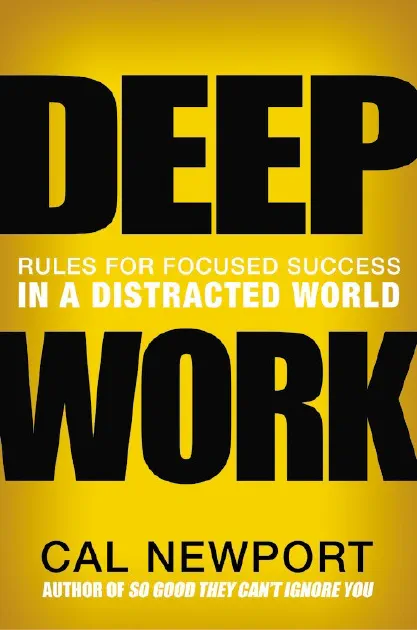
Deep Work: Rules for Focused Success in a Distracted World
by Cal Newport
Review
TLDR; - a book that has some great ideas but could have been shorter :)
While the subject is not groundbreaking for any software practitioner familiar with the “flow” firsthand, I found a few insights to optimize planning my days.
Part I: The context
The first half of the book sets the stage by outlining the idea and asks - do you want to win? Then you must master these two skills by utilizing deep work:
- ability to learn new things quickly
- ability to produce high quality work quickly on a consistent level
“Deep work: professional activities performed in a state of distraction-free concentration that push your cognitive capabilities to the limit. These efforts create new value, improve your skills, and are hard to replicate”
While it’s important to understand what deep work is, it’s equally critical to realize what it’s not.
Deep work is not being superficially busy or working a specific number of hours a day.
“Business as Proxy for Productivity: in the absence of clear indicators of what it means to be productive and valuable in their jobs, many knowledge workers turn back toward an industrial indicator of productivity: doing lots of stuff in a visible matter”
Deep work will also improve your life. The book mentions a study by Mihaly Csikszentmihalyi that showed people are happier when immersed in solving challenges rather than being idle.
Part II: The rules
The second part of the book gives practical methods to create space for your deep work. There is expected advice of “scheduling your deep work” and “creating blocks of electronics free time.”
The author leans heavily on the principles described in other books, like “The 4 Disciplines Of Execution” by Clayton Christensen
- Focus on wildly important
- Act on a lead measures
- Keep a compelling scoreboard
- Create a cadence of accountability
I did like the idea of learning to embrace the boredom as a way of weaning your mind from seeking constant stimuli. Freeing the brain from the voices is not new (the author does mention meditation), but it’s worth to be reminded of.
Another important reminder was an idea that your free time should be planned thoughtfully. I grew up with the saying that “Rest is a switch of an activity type” but had forgotten it over the years.
The takeaway
The book helped to organize and refresh practices I knew but didn’t follow strictly. My daily todo list is now protected from tasks that do not align with the immediate goals.
I also schedule hobbies and personal enrichment activities and don’t feel guilty if some days contain less than a set amount of hours of sitting in front of the computer working.
Overall, the book provides a reminder to organize your life in a purposeful way and contains multiple references to other books and resources for further study.